
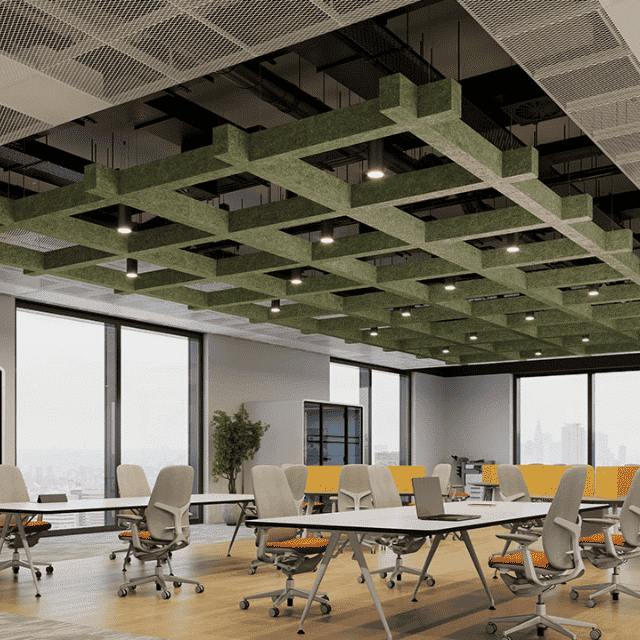
The fully open-plan corporate office is being systematically dismantled by interior designers because it causes severe workplace distractions and cognitive fatigue. While originally built to foster collaboration, open layouts have instead created noisy environments that lower worker output and compromise data privacy. To solve this issue, companies are pivoting to “Acoustic Zoning”—a design layout that uses geometric spatial separation, sound-absorbing composite finishes, and acoustic furniture barriers to create dedicated quiet zones without building permanent drywall partitions.
What Corporate Data Outlines the Value of Acoustic Space Optimization?
The financial and operational costs of unchecked acoustic noise in corporate offices have forced facilities managers to redesign floorplans. Corporate real estate data reveals a direct link between spatial acoustics and employee retention:
| Performance Tracker | Workplace Impact Measurement | Reporting Authority | Year |
| Productivity Loss | up to 86 minutes lost per employee daily due to noise distractions | Steelcase Workplace Survey | 2025 |
| Collaboration Index | 52% improvement in team focus within designated quiet zones | Gensler Research Institute | 2026 |
| Material Integration | 65% surge in high-performance PET felt and sound screen procurement | Commercial Design Index | 2026 |
How Do PET Felt Barriers and Sound Screens Divide Shared Floorplates?
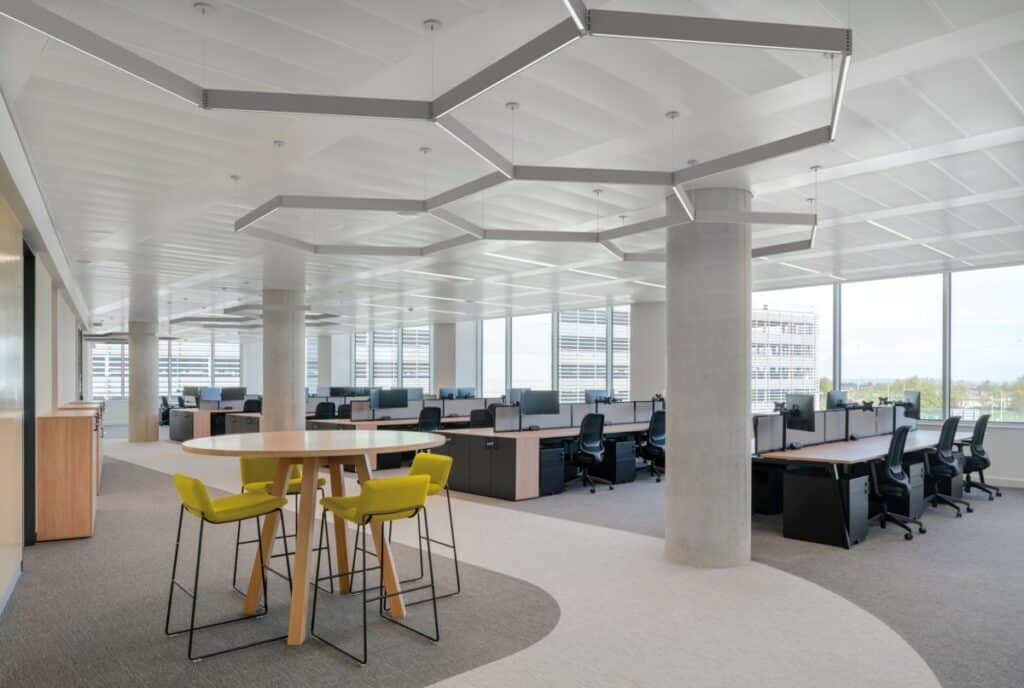
To implement effective acoustic zoning without blocking natural light or airflow, modern interior architecture relies heavily on high-performance poly-ethylene terephthalate (PET) felt barriers. Manufactured from recycled plastics, PET felt features a highly porous micro-texture that captures airborne sound waves, preventing them from bouncing off hard concrete floors or glass windows.
Designers suspend these acoustic baffles vertically from exposed ceilings or deploy them as modular, pinnable workstation dividers. By combining these acoustic panels with soft, sound-dampening flooring materials and irregular wall geometries, offices scatter sound energy naturally. This setup creates distinct quiet microclimates across a single open floorplate, keeping telephone conversations and keyboard noise confined to specific, localized areas.
Why Does Spatial Geometry Replace Traditional Office Drywall Partitioning?
Pivoting to acoustic zoning allows companies to retain the layout flexibility of open spaces while completely avoiding the rigid costs of building permanent interior walls. Designers split large office layouts into four distinct functional zones: focus zones, collaboration zones, social zones, and transition zones.
By placing high-noise social spaces and kitchen breakrooms far away from quiet focus desks, and separating them with structural storage units, book shelves, or vertical green walls, sound waves naturally decay across the distance. This layout strategy eliminates line-of-sight sound transmission, allowing companies to quickly reconfigure office spaces as headcounts change while maintaining excellent acoustic comfort.
Frequently Asked Questions
What is the Noise Reduction Coefficient, and why does it matter in office design?
The Noise Reduction Coefficient (NRC) is a standardised scalar rating (ASTM C423) measuring the fraction of incident sound energy that a material absorbs across the four octave bands most relevant to human speech: 250 Hz, 500 Hz, 1000 Hz, and 2000 Hz. A rating of 0.0 indicates perfect reflection (flat glass, polished concrete, gypsum board); 1.0 indicates complete absorption. In practice: painted concrete NRC ≈ 0.05; carpet NRC ≈ 0.35; standard acoustic ceiling tiles NRC ≈ 0.55–0.70; high-performance PET felt panels NRC ≈ 0.75–0.95. Specifying materials with NRC above 0.70 for ceiling and wall surfaces in focus zones is the standard threshold for WELL Building Standard acoustic comfort compliance — the certification framework increasingly adopted by GCC corporate tenants to attract and retain knowledge workers.
Does acoustic zoning isolate employees and harm team collaboration?
The evidence shows the opposite effect when acoustic zoning is correctly implemented. The Gensler Research Institute’s 2026 Workplace Survey recorded a 52% improvement in team focus within designated quiet zones — and critically, a corresponding increase in the quality of collaboration in designated collaboration zones, where teams report feeling freer to speak at normal volume without guilt about disturbing others. The isolation concern typically arises from poorly designed acoustic schemes that create deadening silences in focus zones rather than comfortable, low-ambient environments. Best practice is to target a Speech Transmission Index (STI) of 0.45–0.50 in focus zones — low enough for conversational privacy but not so anechoic as to feel unnatural. Collaboration zones are designed for STI above 0.65, ensuring clear verbal communication during team sessions.
How can a company apply acoustic zoning to a tight layout on a budget?
Budget acoustic zoning follows a cost hierarchy from lowest to highest investment. Tier 1 (under AED 5,000 for a 200 sqm office): furniture rearrangement to break sightlines between desk clusters; addition of thick-pile area rugs over hard floors (each rug reduces flutter echo by 15–25%); and relocation of high-noise functions (phone booths, printers, kitchen) to the perimeter away from focus desks. Tier 2 (AED 5,000–20,000): freestanding PET felt desk screens (NRC 0.75+) at each workstation; 600mm×600mm suspended acoustic baffles above open-plan areas (targeting 25–30% ceiling coverage); and door seals on existing meeting rooms to improve sound isolation. Tier 3 (AED 20,000–60,000): demountable acoustic partition systems (Framery, Buzzishell, or equivalent) for phone pods and focus booths; acoustic wall panels on the two longest hard walls; and ceiling tile replacement with high-NRC alternatives (0.85+). Most organisations see measurable productivity improvement from Tier 1 and 2 interventions alone, making full structural renovation rarely necessary for acoustic performance gains.
Which GCC corporate offices have implemented acoustic zoning, and what certifications validate acoustic comfort standards?
Acoustic zoning has been adopted across several flagship GCC corporate real estate projects. The NEOM headquarters in Riyadh’s King Abdullah Financial District specified WELL Building Standard v2 acoustic performance requirements — including minimum background noise levels and maximum reverberation times by zone type — as part of its fit-out brief. Several Abu Dhabi Global Market (ADGM) financial tenants on Al Maryah Island have implemented four-zone acoustic layouts as part of WELL Gold certification programmes. The primary certification frameworks for acoustic comfort in the GCC are: WELL Building Standard v2 (Feature 72: Sound Mapping, administered by IWBI at wellcertified.com), which mandates acoustic performance by occupancy type; and LEED v4.1 Indoor Environmental Quality credit EQ-8 (Acoustic Performance), administered by USGBC at usgbc.org. For local regulatory reference, Abu Dhabi’s Estidama Pearl Rating System (PRS) includes Indoor Environment Quality credits covering acoustic performance thresholds relevant to UAE commercial projects. Acoustic consultants certified by the Institute of Acoustics (IOA at ioa.org.uk) or the Acoustical Society of America (acousticalsociety.org) are typically engaged for WELL and LEED acoustic credit documentation.