
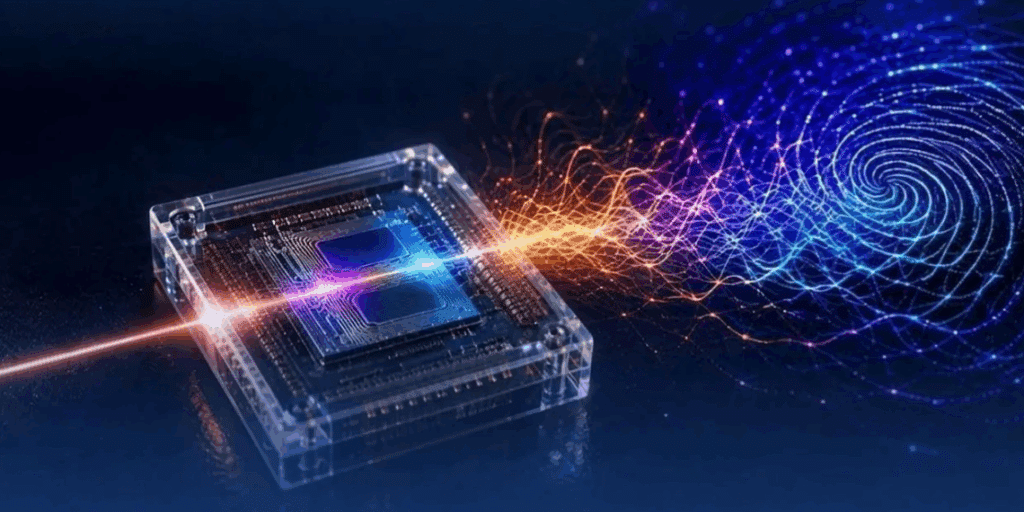
Researchers at King Abdullah University of Science and Technology (KAUST) have developed a new technology that could transform digital security by enabling devices to verify their own identity through their unique physical characteristics, offering a potential alternative to traditional passwords and security keys.
The breakthrough, published in Nature Electronics, addresses a growing challenge in modern digital infrastructure: ensuring that connected devices operating across cloud computing systems, artificial intelligence networks and the Internet of Things (IoT) are authentic, secure and protected from duplication or compromise.
The KAUST-developed system relies on the unique physical properties of miniature laser devices to create highly distinctive digital fingerprints. Similar to human fingerprints, where no two individuals share identical patterns, each laser generates a unique light signature that can be used as an identifier for authentication.
To enhance the accuracy and speed of the process, researchers integrated artificial intelligence into the system, allowing it to analyse and recognise these optical fingerprints almost instantly. This combination of photonics and AI enables devices to independently confirm their authenticity without depending solely on stored passwords, encryption keys or external verification systems.

Principal Investigator, Integrated Photonics Lab
Assistant Professor Yating Wan, who led the research team at KAUST, explained that every connected device requires a reliable method to prove it is genuine. She noted that current approaches often depend on stored security credentials, while the team’s research explores a new model where devices can authenticate themselves using characteristics naturally embedded within their hardware.
According to KAUST, the technology could have significant future applications across large-scale digital ecosystems where millions of devices, sensors and computing systems must communicate securely. Potential applications include cloud computing infrastructure, AI platforms, industrial networks and next-generation connected devices.
During laboratory testing, the system demonstrated extremely fast authentication capabilities while maintaining low energy consumption, highlighting its potential for future computing environments where speed, efficiency and security are critical requirements.
Wan said the rapid growth of artificial intelligence and cloud-based services is increasing demand for new digital security solutions capable of operating at massive scale. She added that the research demonstrates the potential of combining advanced photonic technologies with AI to address emerging cybersecurity challenges.
The KAUST research team continues to explore ways to integrate the technology into future computing and communication systems, with the goal of supporting the development of more secure, efficient and reliable digital infrastructure.