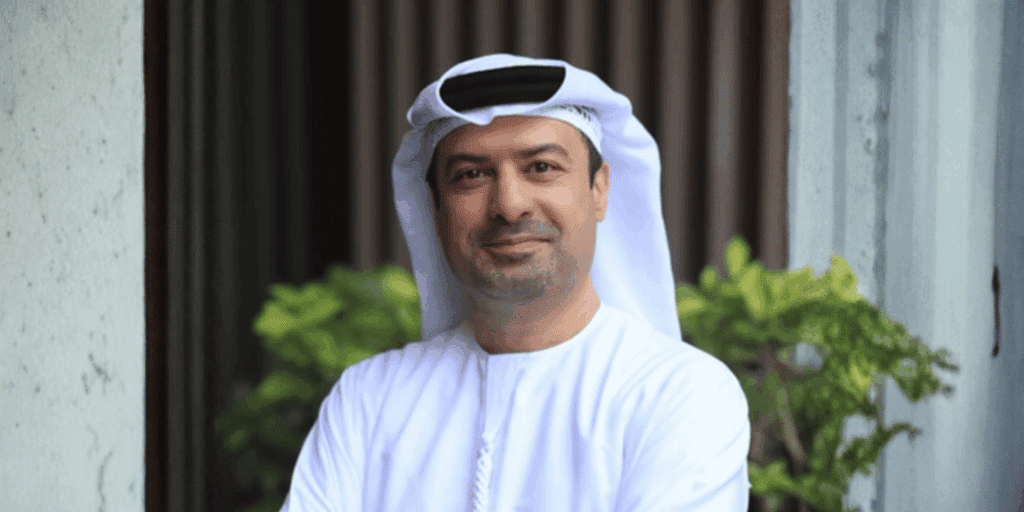
Dr. Marwan Alzarouni cuts a distinctive figure in Dubai’s technology landscape. As CEO of AI at the Department of Economy and Tourism and CEO of the Dubai Blockchain Centre, he holds dual mandates that sit at the intersection of government strategy and frontier technology. With more than two decades in information security, digital forensics, blockchain and AI, he was named one of the top 100 most influential figures in blockchain by CoinTelegraph in 2022 and has served on the World Economic Forum’s Global Future Council on Cryptocurrencies. He was a founding member of both the Dubai Electronic Security Center and the Artificial Intelligence Ethical Committee, and his appointment at DET forms part of Dubai’s Universal Blueprint for Artificial Intelligence, the city’s strategic framework for becoming a global leader in AI implementation.
We spoke with Dr. Alzarouni at the Red Bull Basement UAE National Final, held at The Gate, DIFC, where he sat on the judging panel alongside Lana Sawiris of MONIIFY, Ahmad AlMheiri of Dubai SME, and Mohammad Alblooshi of DIFC Innovation Hub. The global programme, delivered in partnership with DET, DIFC Innovation Hub, Microsoft and AMD, invites students and first-time founders to develop early-stage ideas with the prospect of representing the UAE at the Red Bull Basement World Final in Silicon Valley, competing against teams from more than 40 countries for global exposure and up to USD 100,000 in equity-free funding. This year’s UAE winners, Dev Bhoda and Joshua Koshy, will carry the nation’s flag to that global stage.
The UAE has become a global hub for blockchain and digital innovation. How are initiatives like Red Bull Basement helping to identify and support the next generation of tech talent?
Initiatives like Red Bull Basement play a crucial role in shaping Dubai’s thriving innovation ecosystem. These competitions are essentially structured market intelligence platforms that allow us to see in real time, where innovation is emerging, and how founder priorities are evolving. Through these programmes, we gain a clear view of who is building what, which sectors are gaining traction, and how community interests are shifting across AI, blockchain, sustainability and digital infrastructure.
Dubai is rich with talent, but talent does not scale in isolation. Hackathons, pitch platforms and accelerator programmes create a consolidated arena where founders meet investors, corporates and policymakers under one roof. This cross‑pollination strengthens the entire ecosystem and raises the quality threshold for everyone involved.
One of the biggest challenges early-stage founders face is articulating their vision clearly. When you have just three minutes to pitch your vision, you are forced to distil your concept into its most compelling form. These competitions instill that discipline, helping founders refine their messaging and strengthen their value proposition, sharpen go‑to‑market thinking, and prepare them for real investor scrutiny.
Beyond individual growth, these initiatives lend credibility to our local infrastructure and ecosystem. For example, take Dubai Founders HQ, which has become a central hub for entrepreneurial activity. When international competitions like Red Bull Basement take place here in Dubai, they validate what we’re building and give local startups visibility and access to global exposure they might not otherwise have. The international validation that comes from participating in a recognised platform like this materially improves their ability to raise capital and form strategic partnerships.
All of this aligns directly with the Dubai Economic Agenda, D33, which aims to double the size of the economy by 2033 and increase economic productivity by 50% through innovation and digital adoption. This will help us attract top talent from around the world and nurture the innovation that will further define Dubai’s future digital economy.
From your experience, what qualities in early-stage founders suggest they can scale their ideas successfully in the UAE and internationally?
There’s rarely such a thing as a bad idea. What differentiates successful founders is execution, discipline and adaptability. The most telling indicator of a founder’s potential is the clarity of their go-to-market strategy. Who are they targeting? Are they bootstrapping with limited resources, or have they secured early funding? Regardless of their situation, Dubai offers a unique environment to start from, with infrastructure and support systems that can accommodate various pathways to growth.
We’re particularly focused on founders working in sectors aligned with the D33 Agenda: health, sustainability, logistics, clean energy, proptech, and fintech. These are areas where we’ve seen strong traction, though I should note that healthcare remains an area where we are actively seeking greater innovation and deeper startup participation.
Perhaps the most critical quality I look for is the ability to pivot intelligently. The startup journey is rarely linear. Many of the world’s most successful companies started as something completely different before finding their true product-market fit, Uber being a prime example. Conversely, we’ve seen startups that tried to diversify too quickly and lost focus, only to find success when they doubled down on their core strengths.
What excites me most is working with founders who see Dubai not just as a regional hub, but as a genuine springboard to international markets. The city’s geographic position between East and West, connectivity, world-class regulatory frameworks, and cosmopolitan nature, with close to 200 nationalities represented, make it ideal for testing solutions that can scale globally.
Blockchain and AI are rapidly evolving. How does the UAE ecosystem ensure these technologies are applied in practical, scalable ways rather than remaining experimental?
Dubai’s approach has always been application-led rather than speculation-led, and this is why it stands apart from many other regions. In many parts of the world, blockchain conversations began with cryptocurrency. In Dubai, the focus from 2016 onwards was on practical use cases.
Between 2016 and 2020, we focused on three value-driven applications for blockchain: secure record keeping and notarisation, instant settlement, and automation through smart contracts. Processes that previously required 30 to 45 days were redesigned to operate in near real time. Dubai Now became one of the first live implementations of blockchain-enabled government services, while UAE Pass established secure digital identity infrastructure across sectors.
Automation through smart contracts has been particularly powerful. Smart contracts enable companies to programme actions for payments and other processes automatically. I’ve seen businesses that couldn’t effectively monetise their delivery projects suddenly gain that capability through blockchain-enabled automation.
AI follows a similar pattern of deployment across the value chain. In healthcare, we are already seeing AI move from research environments into practical clinical and scientific applications across the UAE. Recent work led by researchers at Mohamed bin Zayed University of Artificial Intelligence and New York University in Abu Dhabi includes AI systems capable of predicting Alzheimer’s disease up to 20 years before symptoms appear, alongside non-invasive retinal imaging tools that can detect early signs of diabetes, cardiovascular disease, and dementia. In parallel, researchers are advancing smart molecular imaging and cancer-related diagnostic tools, demonstrating how AI is being embedded into preventive care, early detection, and medical research at scale.
But it’s not all about high-level scientific research. For the everyday person, AI is improving last-mile delivery efficiency. Dubai-based logistics company DP World is using AI for optimal container placement, revolutionising logistics operations. These real-world applications demonstrate how we’re embedding these technologies into the fabric of Dubai’s economy.
Dubai’s approach to regulation has been equally pragmatic. Take the Virtual Assets Regulatory Authority (VARA) as an example. Through deep engagement with industry, we identified that regulating activities rather than assets themselves would be more effective. This made Dubai the first jurisdiction worldwide with a dedicated virtual asset regulator, and it has fundamentally changed how the industry thinks about compliance and governance.
This philosophy, starting with practical applications, engaging deeply with industry, and creating enabling regulatory frameworks, means we’re building an ecosystem where innovation translates into tangible economic value and improved quality of life.