Sustainable low carbon concrete utilizes advanced supplementary cementitious materials and carbon-capture curing technologies to reduce the heavy environmental impact of traditional building practices. Because the production of conventional Portland cement accounts for approximately 8% of global carbon dioxide emissions, global construction regulations are forcing a rapid shift toward green alternatives. By blending industrial byproducts with mineralized carbon dioxide, these updated geopolymer mixes match the compressive strength of standard mixtures while reducing embedded greenhouse gases.
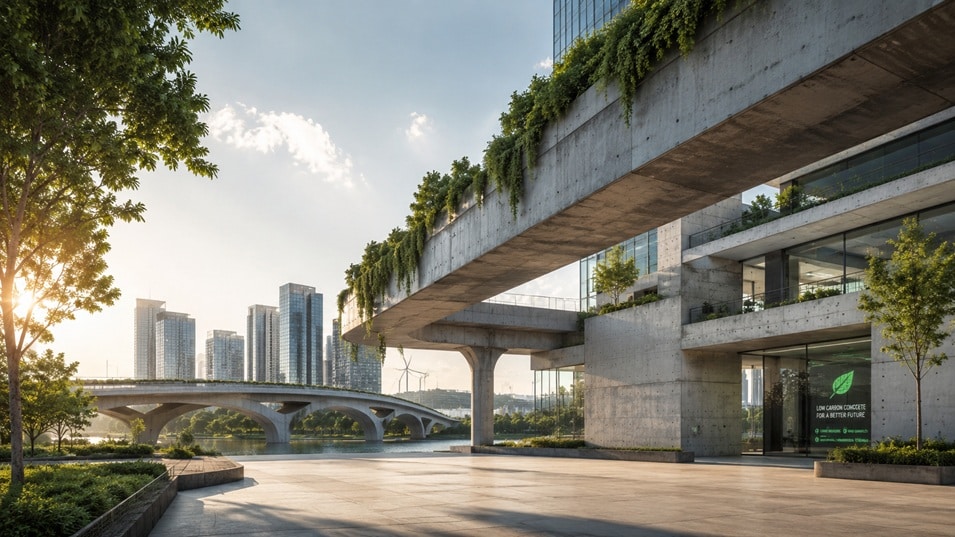
Sustainable Low Carbon Concrete Performance Standards (2026)
| Concrete Composition Type | Carbon Reduction Potential vs. Standard Baseline | Compressive Strength Range | Primary Data Source |
| Geopolymer Fly Ash Mix | Reduces embedded carbon dioxide emissions by 70% to 80% | 40 to 60 MPa (MegaPascals) | Global Cement and Concrete Association |
| Carbon-Cured Formulation | Traps 15kg to 25kg of recycled carbon dioxide per cubic meter | 35 to 55 MPa (MegaPascals) | American Concrete Institute |
| Calcined Clay LC3 Blend | Lowers manufacturing energy consumption by 40% | 45 to 65 MPa (MegaPascals) | EPFL Sustainable Materials Lab |
How Do Industrial Byproducts Eliminate Traditional Portland Cement?
The chemical formulation of low-carbon geopolymer concrete replaces traditional, energy-intensive clinker with industrial waste streams like ground granulated blast-furnace slag and pulverized fly ash. These recycled mineral components are activated using alkaline solutions, triggering a chemical polymerization process that binds aggregates together without requiring high-temperature kiln roasting. This chemical pivot eliminates the primary chemical release of carbon dioxide that occurs during traditional limestone calcination, preserving natural resource reserves worldwide.
What Is Carbon Injection Curing Technology in Structural Engineering?
Modern concrete manufacturing plants are increasingly adopting carbon mineralization technologies to lock captured industrial pollution permanently inside structural building elements. During the initial mixing phase, recycled liquid carbon dioxide is injected directly into the wet concrete paste, where it reacts chemically with calcium ions to form solid calcium carbonate crystals. This trapped mineralization permanently isolates the carbon gas, preventing it from ever entering the atmosphere even if the building is demolished.
Frequently Asked Questions (FAQ)
Does low carbon concrete take longer to cure than standard concrete mixes?
Standard geopolymer mixes using fly ash or GGBS (ground granulated blast-furnace slag) achieve equivalent 28-day compressive strength to conventional Portland cement concrete in the 40–60 MPa range — within normal structural specification tolerances. Early-strength performance varies by mix design: ambient-cured fly ash geopolymers can be slower to reach 3-day strength targets than Portland cement in cool environments, but steam-cured formulations (commonly used in precast manufacturing) develop full structural strength within 24–48 hours. Carbon-injected mixes (using CO₂ mineralisation during mixing) typically show a 10–15% early-strength enhancement over equivalent conventional mixes due to the rapid formation of calcium carbonate crystals that act as micro-aggregate fillers. Contractors should obtain mix-specific test certificates from the supplier and verify compliance with ACI 318 or the relevant national structural code (Eurocode 2 in the GCC context, via BS EN 206) before specifying for structural applications.
Is sustainable green concrete safe to use for high-rise building foundations?
Yes, subject to mix-specific certification. Extensive testing by the American Concrete Institute (ACI) confirms that certified low-carbon mixes can match or exceed conventional concrete across key structural parameters: compressive strength (40–65 MPa depending on mix), flexural tensile strength, and long-term durability in aggressive ground conditions. Geopolymer concrete offers specifically superior chemical resistance to sulfate attack — a critical advantage for deep foundation pours in the Gulf, where high-sulfate soil and groundwater conditions regularly degrade conventional Portland cement foundations over 20–30 year service periods. Thermal cracking risk in massive pours is also measurably lower because geopolymer mixes generate less hydration heat than Portland cement. All structural applications should use mixes certified against ACI 318, ASTM C1709, or equivalent, with third-party batch testing reports required for each foundation pour.
How do developers benefit financially from sourcing low-carbon materials?
The financial case for low-carbon concrete is strongest when assessed across a project’s full capital stack rather than just material cost. Concrete typically represents 15–20% of a commercial high-rise’s total embodied carbon; switching to geopolymer or LC3 blends reduces this contribution by 40–80%, which can be the difference between achieving and failing LEED Platinum or BREEAM Outstanding certification on embodied carbon credits alone. Green building certification directly unlocks green financing: in the UAE, Emirates NBD and Abu Dhabi Islamic Bank both offer green loan facilities at 25–75 basis points below standard commercial rates for certified green buildings. In Saudi Arabia, the Saudi Industrial Development Fund (SIDF) provides concessional financing for factories producing low-carbon construction materials. Additionally, as Saudi Arabia’s National Building Code and Dubai’s Al Sa’fat 2.0 tighten maximum embodied carbon thresholds, projects that already use low-carbon concrete will be insulated from future mandatory material substitution costs.
Which GCC construction projects are currently using low-carbon concrete, and where can engineers source certified suppliers?
Low-carbon concrete adoption is advancing rapidly in the GCC’s giga-project pipeline. NEOM’s procurement specifications mandate minimum embodied carbon thresholds that effectively require geopolymer or blended cementitious materials for qualifying structural elements. The Diriyah Gate Development Authority has specified geopolymer mixes for non-critical structural concrete in several cultural district buildings. In the UAE, Masdar City’s latest expansion phases use carbon-cured concrete as a demonstration of Abu Dhabi’s net-zero construction ambition. For supplier sourcing: the Global Cement and Concrete Association (GCCA) at gccassociation.org maintains a regional member directory including Gulf-based producers of low-carbon concrete products. In Saudi Arabia, Najd Cement, Yamama Cement, and Hail Cement have all published low-carbon product development roadmaps. The Emirates Green Building Council (EGBC) at emiratesgbc.org provides a materials library and verified supplier registry for UAE-based contractors.