
- Sellers have barely budged, with advertised prices just 2% below pre-conflict levels.
- More house-hunters are choosing to rent for now, with new rental contracts just 20% below pre-conflict levels in May, improving from 32% below in March, as buyers and owners wait to close the price gap.
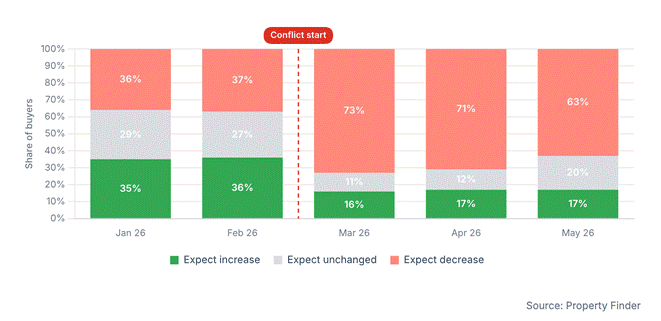
The gap between what UAE buyers expect to pay and what sellers are asking narrowed again in May 2026, according to the latest Property Finder analysis. The share of buyers expecting prices to fall eased to 63%, down from a peak of more than 70% immediately following the onset of the conflict – a second consecutive monthly decline – while sellers’ advertised prices held close to where they were before the conflict.
Before the conflict, buyers were fairly evenly divided on where prices were heading. In Property Finder’s January–February 2026 consumer sentiment poll, buyers were split almost three ways: 36% expected prices to fall, 35% expected them to rise, and 29% thought they would hold steady – a market in which prices were widely seen as high, and views on their next move were mixed.
Once the conflict began, the majority of buyers shifted to expecting price reductions and held back in anticipation of discounts. Expectations of a decline have eased each month since, reaching 63% in May. The direction is consistent: buyer expectations are adjusting, slowly but clearly.
Sellers, by contrast, have moved only marginally. Property Finder’s proprietary listing price index shows advertised asking prices sitting approximately 2% below pre-conflict levels in May, compared with roughly 1% below in April. With sellers largely holding firm, the gap between buyers and sellers is closing, though slowly.
This is the market working through price discovery: the process by which buyers and sellers gradually align on what homes are worth.
“When buyers and sellers sit far apart on price, deals take a pause, and that distance is exactly what’s narrowing now,” said Cherif Sleiman, Chief Revenue Officer at Property Finder. “What matters is how it’s narrowing: through expectations settling, not through panic on either side. A market where more people expect prices to hold is steadier ground than one swinging between fear and optimism, and that steadiness usually has to come first. Typically, the two sides close that gap before deals start picking up again, not after; which is why we watch this behavioral pattern as closely as the transaction numbers itself.”

Demand has not declined so much as redirected. As buyers and sellers continue to align on price, more people are choosing to rent now rather than wait. The volume of new rental contracts in May was only 20% below pre-conflict levels, recovering from 32% below in March, meaning significantly more people are signing new leases than were just two months ago. Nearly half of all rental activity in May consisted of people actively moving into new homes rather than simply renewing where they already lived: a share that has grown from 41% in March to 47% in May. When more people are moving than renewing, it tells you the market has momentum.
Alessia Sheglova, CEO of Dacha Real Estate, noted that this shift reflects a highly strategic consumer base. “From what we are seeing on the ground, this is not a market defined by panic, but by a more disciplined approach from both buyers and sellers. Buyers are negotiating harder and are much more data-driven, but they are also realising that well-priced and desired properties are not being heavily discounted. Sellers, on the other hand, are still holding relatively firm, especially where the property is in a strong location or priced sensibly. The gap is closing, but it is closing through more realistic expectations rather than a sharp correction. For brokers, this is where experience matters most – accurate pricing, honest advice, and managing expectations on both sides allow transactions to move forward.”

Echoing this sentiment, Sam McCone, Managing Partner of McCone Properties, one of the UAE’s leading brokerages said, “On the ground, we are seeing the gap close every day. When the conflict first started we saw a lot of buyers opening with offers well below asking, expecting to find many sellers desperate to sell. And there were a few but all things considered not that many. And now whilst buyers are still negotiating hard, the lowball approach is fading because most buyers have realized that if they’re serious about buying a home in this market they’ll be able to get a good deal but not at a ridiculously low price. Sellers who are priced sensibly are transacting, and the deals that stalled earlier in the year are starting to close once both sides accept where value actually sits.”

Property Finder will continue tracking the gap between buyer and seller expectations as a gauge of where the market stands.