

Figures published by the European Statistical Office, Eurostat, indicated that the euro area posted a €1.0 billion goods trade deficit with the rest of the world in April 2026, reversing the €8.7 billion surplus recorded in April 2025.
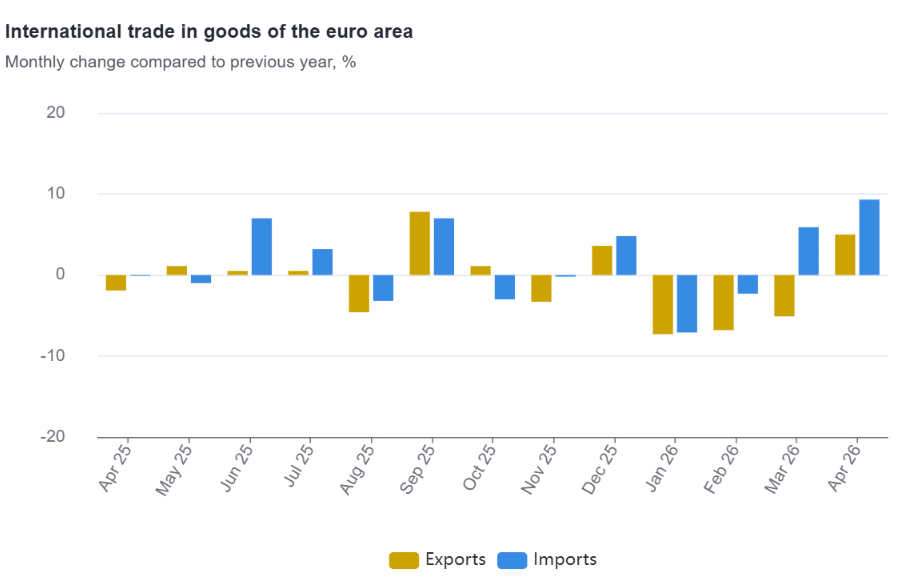
The data showed that euro area exports increased by 5.0 percent year-on-year to €255.4 billion in April 2026, while imports rose at a faster pace of 9.3 percent to €256.4 billion, pushing the trade balance into negative territory.
Compared with March 2026, when the euro area registered a €4.9 billion surplus, trade performance weakened further. On an annual basis, the balance deteriorated by around €9.7 billion, largely reflecting a wider energy deficit and a smaller surplus in machinery and vehicles.
Over the first four months of 2026, euro area exports totaled €970.1 billion, representing a 3.6 percent decline from the corresponding period in 2025, while imports increased by 1.5 percent to €957.2 billion. Intra-euro area trade reached €924.9 billion, up 3.1 percent year-on-year.
For the European Union as a whole, the bloc recorded a €7.1 billion goods trade deficit in April 2026, compared with a €7.3 billion surplus in the same month a year earlier.
EU exports rose by 3.2 percent to €225.7 billion during the month, whereas imports climbed by 10.1 percent to €232.8 billion. This resulted in a €14.4 billion year-on-year deterioration in the trade balance, mainly due to a larger energy shortfall and a reduced surplus in machinery and vehicles.
Between January and April 2026, EU exports declined by 5.8 percent to €857.7 billion, while imports edged up 0.8 percent to €859.9 billion. Meanwhile, intra-EU trade expanded by 4.2 percent to €1.4454 trillion.