- The UAE ranks among the most advanced surveyed markets for AI adoption, with 51% of shoppers using AI-powered chat tools and 91% of businesses already using AI across their e-commerce platforms.
- Marketplaces and social commerce are strong growth channels in the UAE: 51% of shoppers expect to shop more on online marketplaces, while 36% expect to shop more via social media over the next five years.
- Convenience remains central to the UAE e-commerce experience, with 84% of shoppers preferring home delivery and 73% preferring home collection for returns.
- Premium logistics is already mainstream in the UAE, where 64% of shoppers have a paid delivery and returns subscription and 73% of businesses offer one.
AI could soon choose what we buy, sustainability has shifted from nice-to-have to non-negotiable, and second-hand shopping is rapidly becoming mainstream, according to new DHL eCommerce research. The eCommerce Trends Report 2026, based on survey findings from 29,000 online shoppers and 5,800 e-commerce businesses across 29 countries including the United Arab Emirates, highlights the biggest shifts retailers need to prepare for in the coming years and how best to respond to the changing e-commerce landscape.

AbdulAziz Busbate, CEO Middle East and North Africa, DHL Express, said: “The UAE’s strength as an e-commerce market lies in the combination of a highly digital society, strong connectivity global and intraregional and a consumer base that is quick to adopt new online shopping habits. As digital platforms, flexible payment options and delivery expectations continue to shape the market, businesses have a strong foundation for growth. For retailers in the UAE, local relevance and the ability to serve both domestic demand and cross-border opportunities will be key as e-commerce continues to evolve.”
The DHL eCommerce Trends Report 2026 shows that the UAE is among the markets where digital commerce habits are evolving particularly quickly. In the next five years, 52% of UAE shoppers expect to browse and buy more through retailer websites, 51% through online marketplaces, 47% through apps and 37% through AI-powered chat or virtual assistants. On the business side, UAE companies are also preparing for continued channel expansion, with 68% expecting more customer activity through social media, 65% through apps, 64% through online marketplaces and 59% through AI-powered chat or virtual assistants.
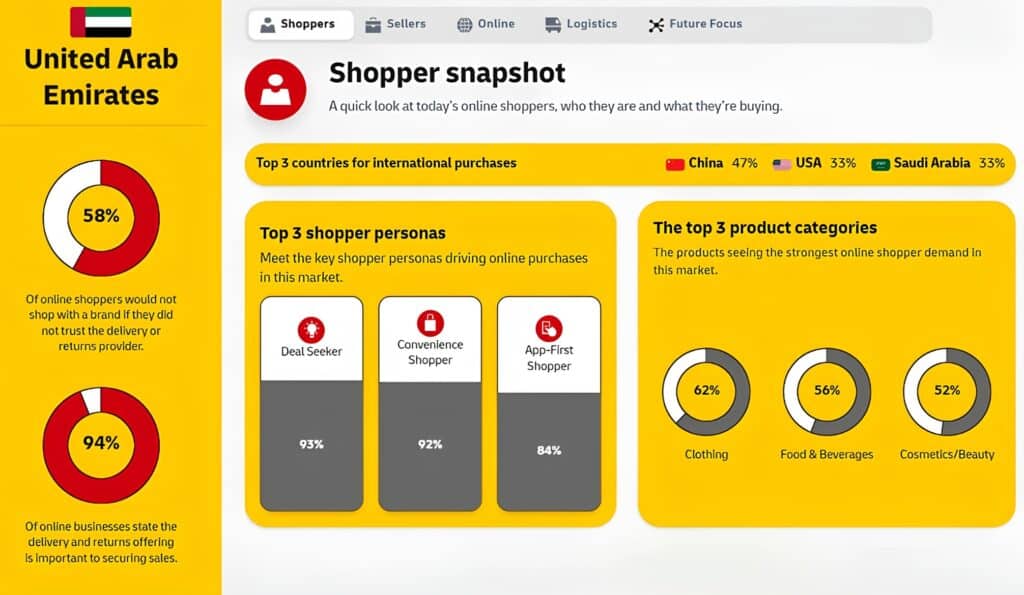
Social commerce also plays a strong role in the UAE. According to the report, 68% of UAE shoppers have purchased through Facebook, 67% through Instagram, 57% through TikTok and 41% through YouTube. Businesses are active across the same channels, with 82% having sold through Facebook, 75% through Instagram, 73% through TikTok and 52% through YouTube. Marketplaces remain highly relevant as well, with Amazon identified as the most popular online marketplace for both UAE shoppers and businesses.
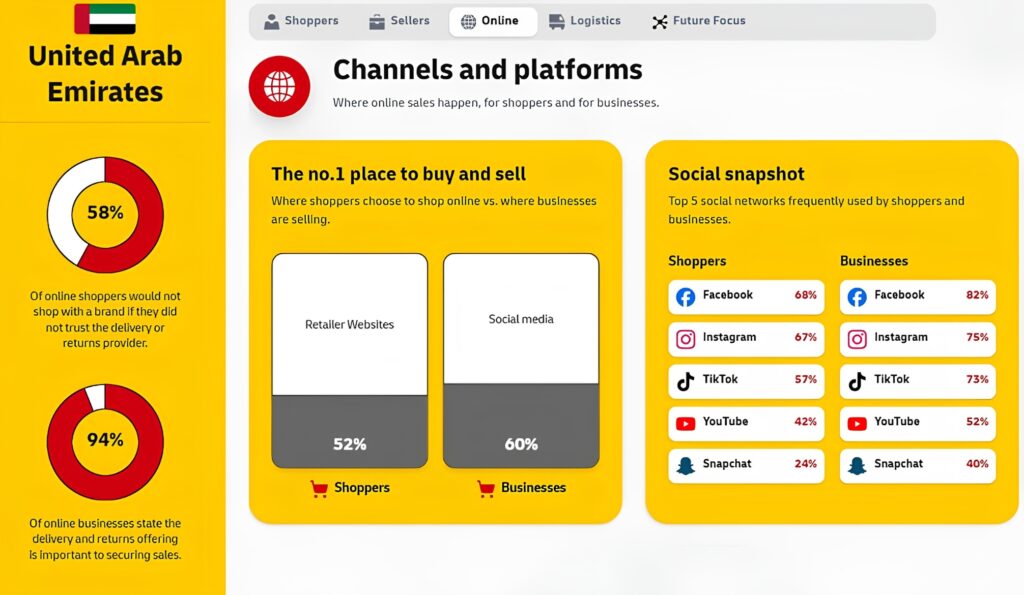
The global e-commerce market is also experiencing rapid behavioral shifts, widening an expectation gap between what modern shoppers demand and what online businesses are prepared to deliver. AI is transforming buyer habits and accelerating innovation across the e-commerce ecosystem. In doing so, it is beginning to upend traditional formats and could even lead to the disappearance of virtual storefronts. Securing consumer loyalty in this changing landscape requires moving past transactional speed to master checkout trust, payment choice, and localized delivery convenience.

Pablo Ciano, CEO of DHL eCommerce, said: “The ability to understand and respond to customer needs has always defined success – but our new eCommerce trend report shows that AI is now redefining that advantage at hyperspeed. Consumers can identify the best offer in milliseconds, and retailers can gain insights that allow them to instantly capitalize on changing demand. For those of us powering the delivery infrastructure behind e-commerce, AI enables new levels of speed, flexibility, and precision. In this new era, the winners will be those who move fastest – and translate that speed into superior customer experiences.”
To help brands navigate this rapidly evolving landscape, DHL eCommerce has identified the key short and longer-term trends that businesses simply can’t afford to ignore:
The next online shopper may not be human
Almost a third (29%) of shoppers (rising to 33% of Gen Z and 36% of millennials) say they would be happy to hand over control of their shopping to AI and let it make shopping decisions or purchases for them in the next five years, with almost two thirds (59%) of businesses expecting shoppers to browse and buy through virtual assistants in the future.
As generative AI continues to reshape the entire shopping journey – from product discovery to post-purchase support – 73% of businesses anticipate using it more over the next five years, despite consumer concerns about privacy and trust (48%).
In the UAE, this shift is already visible, with 51% of shoppers using AI-powered chat tools when shopping online, placing the country among the top surveyed markets for AI-assisted shopping. On the business side, 91% of UAE e-commerce businesses already use some form of AI across their platforms, and 84% expect AI usage to increase over the next five years.
Out-of-home delivery becomes the new standard
For consumers, the desire for delivery innovation comes from a continued need for convenience and flexibility, with a fifth (20%) of shoppers stating that faster delivery would encourage them to complete their purchase, and three in ten now looking to OOH delivery locations to meet the needs of their busy lives. To capture this trend, businesses will need fulfillment setups that offer greater flexibility, reliability, and convenient pickup and return options.
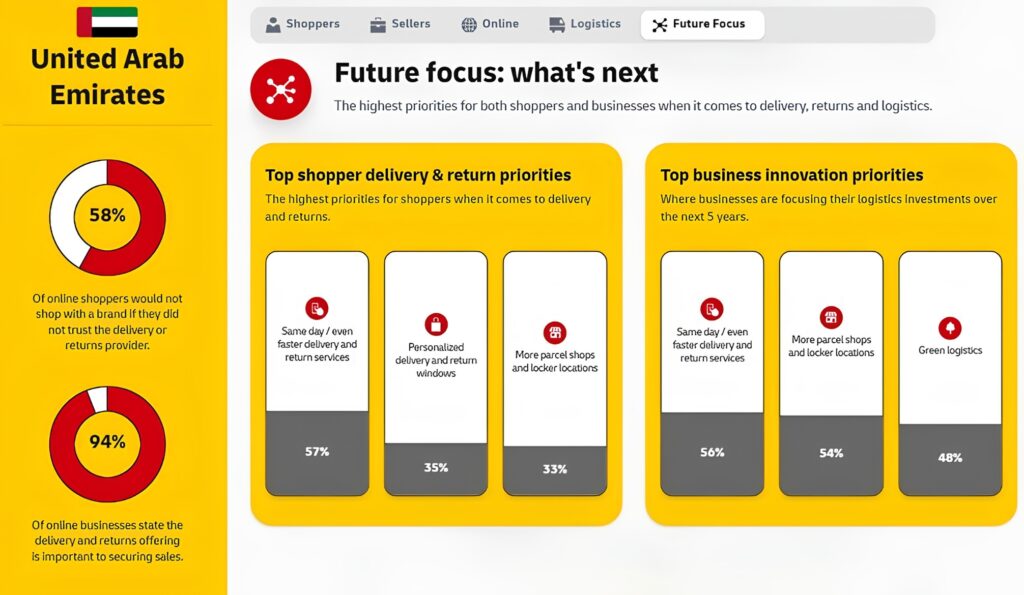
In the UAE, convenience remains strongly home led: 84% of shoppers prefer home delivery, while 73% prefer home collection for returns. At the same time, out-of-home options are gaining relevance, with 12% using parcel lockers for deliveries and 23% using parcel lockers for returns. UAE shoppers also show strong appetite for premium logistics: 64% already have a paid delivery and returns subscription, while 73% of businesses offer one and a further 24% plan to introduce one.
Free delivery and returns remain a key motivator for shoppers to close sales, posing an ongoing challenge to online retailers’ costs and margins in a competitive marketplace, although trust and choice of delivery partners are highlighted by 7 out of 10 shoppers as critical factors when choosing a brand to shop. A similar misalignment is occurring at the digital checkout counter: A massive 62% of shoppers say they will immediately abandon a purchase if their preferred payment method is unavailable, yet only 45% of businesses currently recognize this as a key driver of cart abandonment.
The home will become a sustainable side hustle
The line between shopper and seller continues to blur as second-hand consumer-to-consumer (C2C) shopping is set to go mainstream. One in two (52%) consumers have sold an item on an online marketplace, rising to 62% amongst Millennials and 58% amongst Gen Z, although Baby Boomers trail behind on 35%. Globally, Europeans are the most active in C2C selling, with 57% saying they sell on marketplaces.
While not the case for every consumer, many are turning to online buying and selling to adopt more sustainable habits, with 45% saying they purchase second-hand and refurbished items for sustainability reasons, and a further 15% saying they would consider it in the future.
There is also a clear global shift underway, with markets including the UAE, Nigeria, India, Malaysia and Saudi Arabia already leading circular and sustainable initiatives, driven particularly by millennials and medium-sized businesses at the forefront of more sustainable e-commerce practices.
Overall, sustainable logistics – once seen as a competitive differentiator for retailers and logistics partners – is now expected to become a standard expectation by 42% of consumers over the next five years.
About the DHL eCommerce Trends Report 2026
The DHL eCommerce Trends Report 2026 surveyed 29,000 consumers and 5,800 businesses across Europe, North America, Asia-Pacific, Latin America, the Middle East, and Sub-Saharan Africa. By combining shopper and business perspectives into a single unified view, the report provides practical insights to help e-commerce brands respond to evolving operational demands.
Further insights and the full report are available at:
• dhl.com/2026-report
• dhl.com/reports
• dhl.com/e-commerce-report