

Five years into the Make it in the Emirates programme, the UAE’s industrial sector has doubled in economic contribution — and the government is using the 2026 edition to raise the ambition level considerably further.

The fifth edition of Make it in the Emirates (MIITE 2026) opened at ADNEC Centre Abu Dhabi on 4 May 2026 with 1,245 exhibitors across 88,000 square metres — the largest edition of the forum since its inaugural run in 2021. Dr Sultan Ahmed Al Jaber, Minister of Industry and Advanced Technology, announced that the UAE’s industrial sector contribution has reached AED200 billion, a 70% increase since 2021, while industrial exports climbed to AED262 billion, including AED92 billion classified as advanced industrial exports. Alongside the milestone, the government unveiled an AED180 billion industrial procurement localisation target — the headline initiative of MIITE 2026 that sets the policy agenda for the next five years.
The AED180 billion figure refers to the value of products and services that the UAE intends to procure locally rather than import over the programme’s life cycle. The initiative targets more than 5,000 specific products across strategic sectors, including advanced manufacturing, pharmaceuticals and medical technology, aerospace and defence, clean energy infrastructure, and construction materials. The government simultaneously announced an AED1 billion National Industrial Resilience Fund, designed to support companies localising production in vital sectors and building strategic reserves across food, medicine, and industrial components.
The scale of the procurement localisation ambition is significant in GCC context. Saudi Arabia’s In-Kingdom Total Value Add (IKTVA) programme — which requires Aramco and its supply chain to retain 75% of procurement spending inside the Kingdom — is the closest regional precedent. The UAE’s AED180 billion target applies more broadly, across federal government entities and all companies with at least 25% direct or indirect federal ownership.
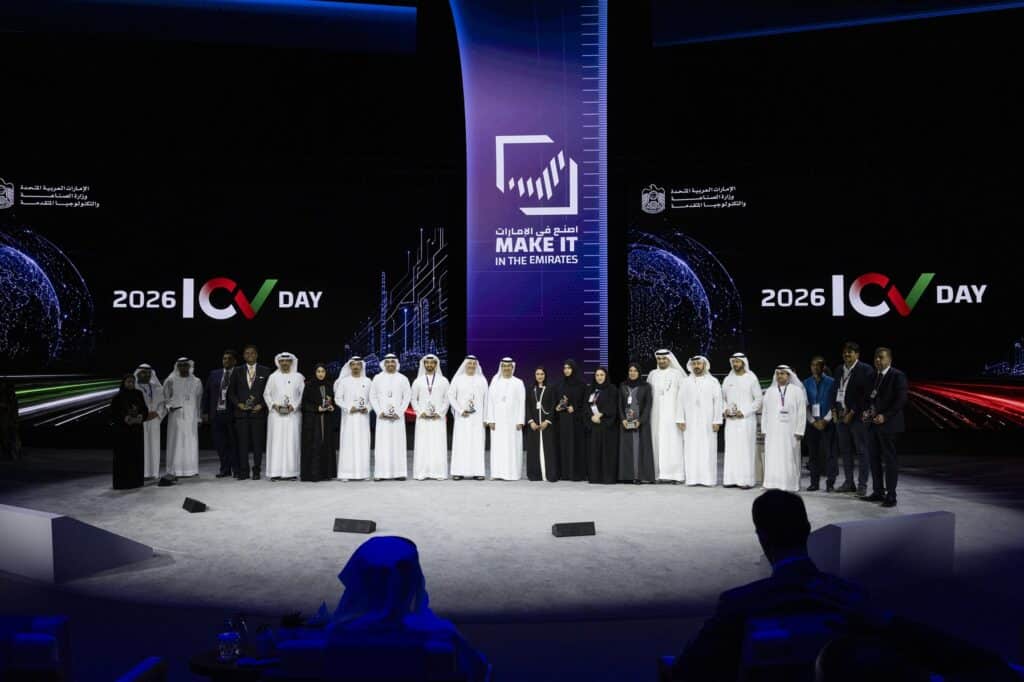
The expanded In-Country Value (ICV) framework announced at MIITE 2026 makes ICV certification mandatory for a substantially wider group of entities than before. Previously, ICV requirements applied primarily to oil and gas and government procurement chains; the new framework extends mandatory coverage to all federal government entities and those with significant public ownership.
For multinationals and regional businesses that supply to the UAE government, the expansion creates a compliance obligation with real commercial consequences — companies without ICV certification risk losing access to federal contracts. The framework also creates opportunity: manufacturers willing to establish UAE production capacity or hire UAE nationals will benefit from scoring advantages in the ICV methodology.
Sectors With the Most Scope
Dr. Al Jaber’s comments at MIITE 2026 identified four sectors as the priority focus areas: pharmaceuticals and medical technology; advanced manufacturing integrated with AI and Industry 4.0 systems; future energy and industrial decarbonisation; and aerospace, defence, and automotive. These sectors were selected on the basis of the UAE’s comparative advantages — regulatory speed, geographic position, free zone infrastructure, and sovereign investment capacity — and the degree to which they align with global supply chain diversification trends following pandemic-era disruptions.
The forum’s 12 priority industry tracks, alongside partnerships with ADNOC, Mubadala, and international manufacturers including Boeing and Siemens, signal that the government is not merely setting targets but actively curating the investor base needed to meet them.
For manufacturers operating in or considering entry into the UAE, MIITE 2026 delivers a clear signal: the government is willing to direct significant procurement spending toward domestic producers, but expects in return genuine manufacturing presence, local employment, and technology transfer — not warehousing or light assembly disguised as local production.
For investors, the AED200 billion sector milestone and the AED180 billion procurement target together imply a sustained pipeline of industrial real estate, logistics infrastructure, and skills training investment.