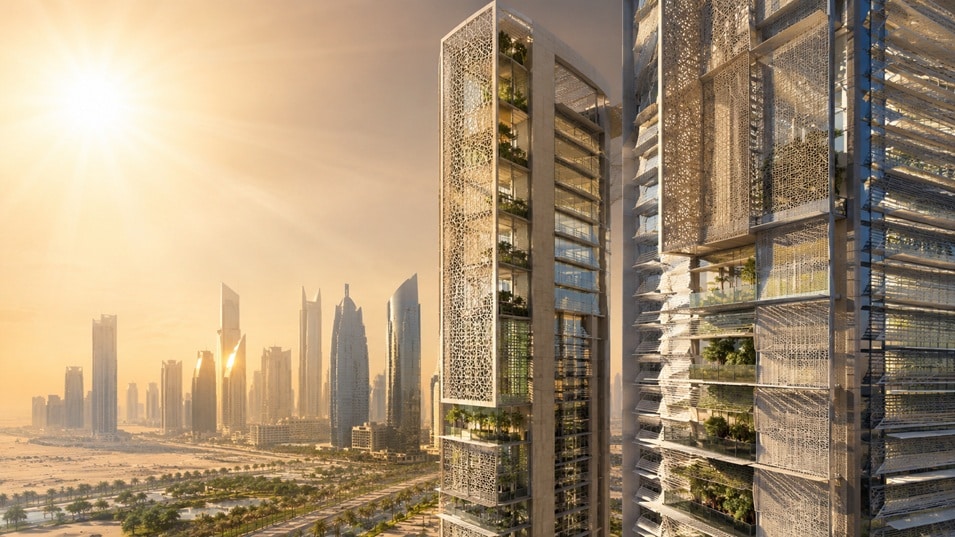
Adaptive facade systems are revolutionizing high-density construction across the Gulf Cooperation Council (GCC) by replacing traditional, static glass envelopes with automated, climate-responsive building skins. In arid metropolitan hubs where structural cooling demands account for up to 70% of an asset’s lifetime electricity usage, these kinetic systems act as a protective barrier against intense solar radiation. Driven by structural realignments like the newly announced Cooling Riyadh Project and the UAE’s smart building regulations, dynamic shading networks automatically adjust throughout the day to reduce thermal absorption, insulate internal cooling systems, and lower building operating costs.
Kinetic Performance Metrics and Thermal Shading Standards (2026)
| Facade Engineering Variant | HVAC Energy Savings Potential | Carbon Footprint Offset Target | Primary Engineering Source | Evaluation Baseline |
| Kinetic Origami Shading | 30% to 50% Reduction in Cooling Load | 1,750 Tonnes of Annual Carbon Carbon Dioxide Savings | Council on Tall Buildings and Urban Habitat | 2026 |
| Terracotta Passive Ventilators | 25% Reduction in Radiant Heat Gain | Optimized Airflow Microclimates | Desert Architecture Forum KSA | 2026 |
| Shape Memory Alloy Fins | 30% Peak HVAC Load Mitigation | 0% Secondary Actuator Energy Draw | International Journal of Architectural Computing | 2026 |
| Reflective Smart Glazing | 15% to 20% Base Thermal Mitigation | High-E Triple-Glazed Barrier | Dubai Municipality Smart Architectural Code | 2026 |
Why Is the Cooling Riyadh Project Mandating Thermal-Reflective Facades?
The Royal Commission for Riyadh City (RCRC) has introduced comprehensive urban building guidelines under the 2026 Cooling Riyadh Project to combat the urban heat island effect across dense commercial districts. The new engineering directives restrict the utilization of unshaded dark glass and high-absorption dark concrete surfaces that store heat during daytime peaks. Instead, new corporate submissions must implement reflective, light-colored architectural facades and automated kinetic fins that track solar paths, dropping building surface temperatures by 8 to 15 degrees Celsius to reduce localized heat buildup.
How Do Automated Kinetic Panels Lower Skyscraper Cooling Demands?
Dynamic facade mechanisms operate via a network of computer-guided motorized actuators, wind sensors, and solar trackers that systematically recalculate panel positioning based on seasonal angles. When intense morning rays hit an eastern skyscraper facade, the regional sensor grid automatically prompts a secondary skin of protective panels to expand, forming a continuous physical shade barrier over the structural core. A premier example of this approach is the Al Bahar Towers in Abu Dhabi, where an origami-inspired honeycomb facade folds open and shut throughout the day, blocking direct solar glare while allowing indirect light to pass into the offices.
Which Passive Materials Support Climate-Responsive Building Skins?
Beyond motorized mechanical louvers, modern high-rise engineering teams are incorporating high-performance passive materials like structural ceramics and shape memory alloys into high-rise facades to secure long-term structural resilience. Thick terracotta panel systems are increasingly utilized as protective outer screens, using natural thermal massing to delay heat transfer into building cores until nighttime temperatures drop. Additionally, advanced smart fins utilize materials that automatically flex open or shut in direct response to surrounding air temperature shifts, eliminating the need for complex internal wiring or continuous electrical consumption.
Frequently Asked Questions (FAQ)
What is the primary purpose of an adaptive facade system in desert climates?
In Gulf desert climates, adaptive facades serve as a dynamic buffer between the exterior thermal environment and the conditioned interior. Their primary objective is solar radiation interception: by positioning shading elements — louvers, kinetic panels, or smart glazing layers — between the sun and the building’s primary glass envelope, they prevent the radiant heat that would otherwise drive cooling demand. The secondary objective is daylight management: unlike static, fully opaque shading, adaptive systems modulate their position throughout the day to allow diffuse daylight in while blocking direct beam radiation, maintaining comfortable interior luminance levels without artificial lighting during daylight hours. In GCC commercial buildings where HVAC accounts for up to 70% of total electricity consumption, a 30–50% reduction in cooling load from adaptive facades translates directly into 20–35% reductions in total building electricity bills — typically recovering the additional capital cost within five to seven years of commissioning.
How do kinetic building skins handle intense dust and sandstorms?
Sandstorm resilience is a mandatory design requirement for any adaptive facade system specified in Saudi Arabia, the UAE, Kuwait, or Qatar. Modern systems use a multi-sensor protective protocol: anemometers monitor wind speed continuously, and particulate density sensors (PM10 and PM2.5 monitors) detect sand and dust concentration in real time. When wind speed exceeds a project-specific threshold — typically 60–80 km/h depending on panel geometry and actuator capacity — all panels automatically retract to a closed, flush-to-frame stow position that presents minimum wind resistance and protects actuator mechanisms, track systems, and motorised pivot joints from abrasive particles. Track systems use sealed IP67-rated housing for all electronic components, and actuator mechanisms are specified in marine-grade stainless steel or powder-coated aluminium with sealed bearings. Post-storm self-cleaning protocols (typically a programmed slow open-close cycle to shed deposited dust) are integrated into the Building Management System (BMS) automation logic. Maintenance intervals for Gulf-deployed kinetic systems are typically every 6 months versus 12 months in temperate climates.
Are adaptive building facades financially viable given their high installation costs?
Adaptive facade systems carry a capital cost premium of 15–40% over conventional curtain wall systems depending on technology type — kinetic mechanical systems sit at the higher end, smart electrochromic glazing at the lower end. However, lifecycle financial analysis consistently favours adaptive systems in Gulf climates. The rapid 30% to 50% drop in annual cooling electricity consumption typically delivers full capital recovery within five to seven years in Gulf commercial buildings, where electricity tariffs for corporate tenants range from AED 0.38 to AED 0.44 per kWh in Dubai and SAR 0.18 to SAR 0.26 per kWh for commercial users in Saudi Arabia. Beyond energy savings, adaptive facades directly support Al Sa’fat 2.0 Gold and Platinum rating requirements in Dubai and Mostadam’s energy efficiency credits in Saudi Arabia — certifications that unlock green financing at rates 25–75 basis points below standard commercial terms. Asset valuations also benefit: CBRE’s 2025 GCC Green Building Premium report showed certified green commercial buildings command 8–12% higher lease rates and 5–8% higher capital values than equivalent non-certified stock.
Which regulatory bodies in the GCC require adaptive facade systems, and where can developers access the relevant compliance frameworks?
Adaptive facade mandates are advancing at different speeds across GCC member states. In Dubai, the Smart Architectural Code launched in 2026 requires all new commercial buildings to achieve Al Sa’fat 2.0 Silver rating minimum — a standard that effectively mandates some form of dynamic or high-performance shading for buildings with significant east, west, or south glass exposure. The full code and Al Sa’fat 2.0 guidelines are published at dm.gov.ae. In Saudi Arabia, the Cooling Riyadh Project under the Royal Commission for Riyadh City (RCRC) mandates reflective and kinetic facades for new commercial development in designated urban heat island zones; RCRC publishes its urban design guidelines at rcrc.gov.sa. Abu Dhabi’s Estidama Pearl Rating System (Version 2) includes facade thermal performance credits that push high-specification commercial projects toward adaptive systems; documentation at ead.gov.ae. For project specification, the Council on Tall Buildings and Urban Habitat (CTBUH) at ctbuh.org publishes technical guidance on adaptive facade engineering, and the façade engineering firm Arup’s GCC office (arup.com) is a reference practice for adaptive system specification in the region.