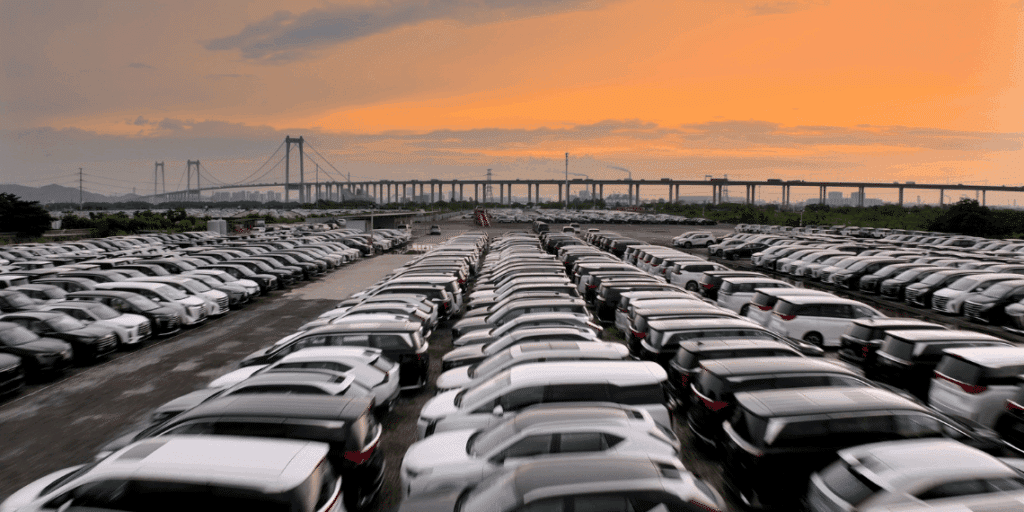
Saudi Arabia imported 1.9 million vehicles in two years, and for the first time, China ranked first among suppliers. The shift in where Saudi Arabians buy their cars reflects a broader realignment in trade relationships that extends well beyond the automotive sector.
Saudi Arabia imported approximately 1.9 million vehicles over the 2024-2025 period, with China ranking first among source countries — ahead of Japan, India, Thailand, and South Korea — citing official import records. Annual imports reached roughly 959,000 units in 2025, following approximately 942,000 in 2024. China’s ascent to the top of the Saudi vehicle import ranking marks a pronounced shift in a market long shaped by Japanese and Korean manufacturers whose brand loyalty among Saudi consumers was considered one of the most durable in the region.
How Chinese Automakers Won Saudi Arabia
The success of Chinese vehicle brands in Saudi Arabia rests on a convergence of factors that has played out across multiple emerging markets simultaneously. First, pricing: Chinese manufacturers — including BYD, Chery, SAIC (MG), JAC, and Geely — offer vehicles in the SAR 50,000 to SAR 120,000 range with equipment levels that match or exceed Japanese and Korean competitors at the same price point. Saudi consumers, sensitive to value for money in the mass-market vehicle segment, have responded by switching brands at a rate that has surprised incumbents.
Second, product range: Chinese automakers have invested heavily in SUVs, crossovers, hybrids, and electric vehicles — precisely the vehicle categories that Saudi consumers have adopted most rapidly. Saudi Arabia’s domestic fuel subsidy structure historically made fuel economy a secondary purchasing consideration, but rising fuel costs and growing interest in EVs among younger Saudi consumers have made Chinese brands’ hybrid and electric offerings commercially viable for the first time.
Third, rapid service network expansion: Chinese manufacturers entering Saudi Arabia in 2022-2024 invested aggressively in after-sales network build-out — a historical weakness of Chinese brands in the Middle East — and the establishment of owned and authorised service centres across Riyadh, Jeddah, Dammam, and secondary cities has addressed a persistent buyer hesitation.
Implications for Japanese and Korean OEMs
Toyota, Hyundai, and Kia — which have historically dominated the Saudi market — face the most direct competitive pressure. Toyota’s Land Cruiser and Hilux remain category leaders in the utility and pick-up segments where brand loyalty and parts network depth are particularly important, providing some insulation from Chinese competition. Hyundai and Kia face greater displacement risk in the mass-market passenger and SUV categories where Chinese brands’ price-to-specification advantages are strongest.
Japanese and Korean manufacturers are responding with product refreshes, revised pricing strategies, and expanded local aftersales investment. Whether they can arrest the market share shift or whether the current trajectory continues toward Chinese market dominance will be a defining question for the Saudi automotive market through 2026 and 2027.