Saudi Arabia is actively exploring diplomatic frameworks by floating a structured proposal for a regional non-aggression pact. Modeled after Europe’s historic 1975 Helsinki Accords, the initiative seeks to establish binding security guarantees across the Middle East. By reducing political friction and securing vital maritime and overland transit corridors, the framework acts as a strategic mechanism to safeguard trillion-dollar sovereign investments and insulate private sector supply chains from external volatility.
Strategic Indicators: Regional Infrastructure Security (May 2026)
| Metric / Framework Component | Target Impact / Status | Primary Objective | Year |
| Bilateral Focus | Saudi Arabia–Iran Logistics Security | Secure Maritime/Energy Supply Chains | 2026 |
| Model Inspiration | 1975 Helsinki Accords (“Basket” Structure) | Sovereign Immunity & Trade Continuity | 2026 |
| Core Economic Driver | Protection of Vision 2030 Giga-Projects | De-risk Foreign Direct Investment (FDI) | 2026 |
| Co-lateral Diplomacy | UK-Saudi Security & Capital Directives | Strategic Defense Tech Integration | 2026 |
Why is the “Helsinki Model” being applied to Middle Eastern commerce?
The choice of the Helsinki framework represents an analytical approach to regional risk management. Instead of demanding immediate ideological alignment, the model divides complex relationships into distinct functional categories, or “baskets,” focusing heavily on sovereign security guarantees and economic cooperation. The absolute priority for the Saudi Ministry of Foreign Affairs is creating an environment where cross-border trade, energy transit, and infrastructure developments are legally insulated from political escalations, offering long-term visibility to global logistics firms.
How does this diplomatic framework protect Vision 2030 investments?
The proposal is directly tied to the financial security of the Kingdom’s massive domestic expansion programs. High-level diplomatic discussions highlight that foreign capital demands predictable regional stability. By floating a non-aggression pact, the Kingdom is moving to eliminate the risk premium often associated with Middle Eastern industrial investments, ensuring that manufacturing hubs, data centers, and urban centers develop without the threat of regional supply chain blockades.
What role do global business alliances play in validating this security pact?
For a regional pact to succeed, it must be reinforced by international industrial partnerships that establish a shared economic stake in local stability. The recent expansion of Western defense tech collaborations and the integration of British capital into localized supply chains serve as practical anchors for this diplomacy. By weaving major global economies directly into the industrial fabric of the Gulf Cooperation Council (GCC), Riyadh is ensuring that any disruption to regional commerce carries immediate, global economic consequences, thereby reinforcing deterrence through integrated financial interests.
Frequently Asked Questions (FAQ)
What is the “Helsinki Model” in diplomacy?
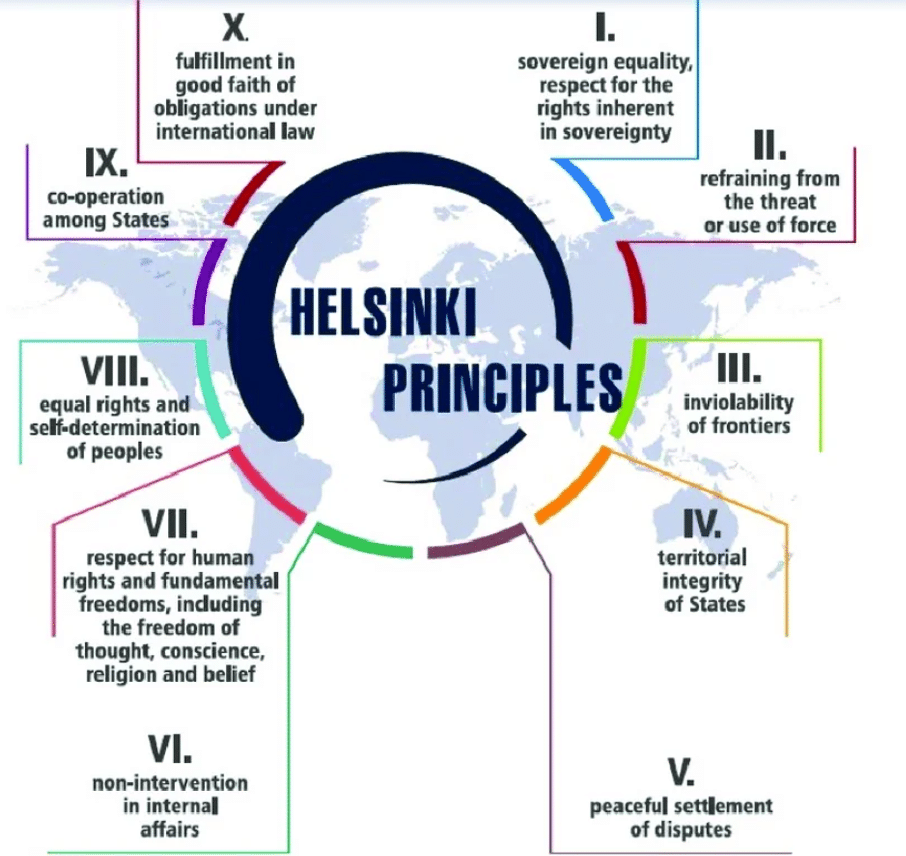
The Helsinki Model refers to the diplomatic architecture of the 1975 Helsinki Final Act, signed by 35 nations including the US, USSR, and all European states. Its defining feature was the “basket” structure: rather than requiring a single comprehensive agreement, it allowed adversarial blocs to sign onto separate thematic baskets covering (1) security and sovereignty, (2) economic and scientific cooperation, and (3) humanitarian rights — enabling partial consensus even where full alignment was impossible. Saudi Arabia’s proposed adaptation applies this same modular logic to the Middle East, separating trade and logistics security from broader political and ideological disputes to enable practical economic cooperation without demanding full normalisation.
How does this pact differ from previous regional security agreements?
Previous Middle Eastern security arrangements have typically been bilateral defence treaties (such as the US-Gulf security frameworks) or multilateral political declarations that require ideological consensus before economic provisions activate. Riyadh’s Helsinki-inspired proposal inverts this order: economic and infrastructure security commitments are the primary “basket,” treated as separable from political alignment. Practically, this means a non-aggression guarantee covering Strait of Hormuz shipping lanes, cross-border pipeline corridors, and industrial zone sovereignty could be activated without requiring full diplomatic normalisation between all signatories — a significantly lower threshold for initial participation.
Will international private companies be affected by this framework?
Yes, materially. Multinational corporations operating in the GCC currently price a geopolitical risk premium into their MENA investments — reflected in higher political risk insurance rates, shortened investment horizons, and conservative capital commitments. A binding regional non-aggression framework, even a partial one, would directly reduce these risk premiums. Practically, companies would benefit from: more predictable cargo insurance rates for Gulf shipping routes; faster customs processing at shared border crossings covered by the pact; reduced force majeure clauses in long-term supply contracts; and greater willingness from global institutional investors to extend long-tenor project financing to Vision 2030 and similar regional mega-projects.
Where can businesses track official updates on this initiative?
Official diplomatic statements and framework developments are managed and published through the Saudi Press Agency (SPA) (spa.gov.sa) and verified diplomatic channels. The Saudi Ministry of Foreign Affairs (mofa.gov.sa) publishes official position papers and joint communiqués after each bilateral engagement. For academic and policy analysis of the Helsinki framework and its regional application, the King Faisal Center for Research and Islamic Studies (kfcris.com) regularly publishes relevant geopolitical research. Businesses tracking the commercial implications of this initiative should monitor ZAWYA and the Saudi Gazette for deal-flow updates linked to the diplomatic track.