Geopolitical shocks come and go. Dubai’s real estate market has outlasted every single one of them — and the numbers prove it.
The headlines in early 2026 were, by any measure, alarming. US-Israel strikes on Iran sent a tremor through global markets. The DFM Real Estate Index shed roughly 20% in days. Transaction volumes fell. Sentiment wavered. And the familiar chorus returned: Is Dubai finally finished?
It is a question I have heard many times over a career spanning 25 years across this region. In 2008. In 2013. During the oil price collapse of 2014–2016. During COVID. During the Russia-Ukraine war. Every single time, the obituary writers were wrong. Dubai did not merely survive — it surpassed every previous record. Understanding why requires going back to the crises themselves, reading them honestly, and drawing the one lesson that matters most: this city has learned from pain, and it has systematically rebuilt itself into something structurally different after each episode.
2008: The Year Dubai Almost Broke
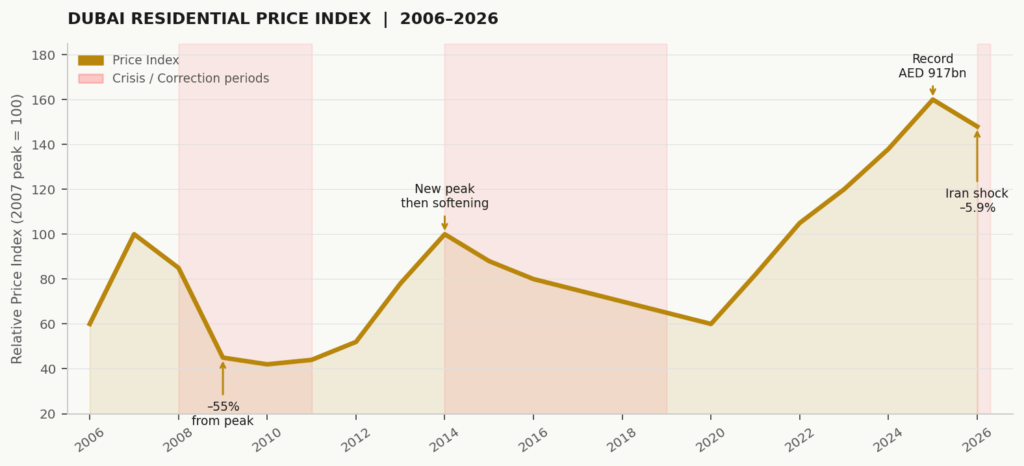
The global financial crisis of 2008 exposed the full fragility of what Dubai had built during its first speculative boom. Property values dropped between 40% and 60% from peak levels. Iconic mega-projects — Palm Islands developments, Jumeirah Gardens City — were halted or cancelled. Over $300 billion worth of projects were scaled back or abandoned. Key government-linked entities including Dubai World and Nakheel faced debt crises that rattled international confidence. The expatriate population contracted. Offices emptied. Mortgages went into default.
The market was, by any technical definition, broken. It had been built on a foundation of speculative short-horizon buying, leverage, and rapid resale expectations. When global liquidity dried up, that foundation dissolved overnight. Prices did not merely correct; they collapsed — because the market had not been pricing genuine end-user demand. It had been pricing the expectation that someone else would pay more tomorrow. I have seen that pattern in multiple markets across this region. It never ends well.
“The 2008 crisis did not destroy Dubai’s real estate market. It created the conditions for a fundamentally better one.”
What followed, however, was not paralysis. The government’s response was decisive and structural. The Real Estate Regulatory Authority (RERA) was empowered with genuine enforcement capability. Escrow account requirements were mandated for all off-plan developers, protecting buyer funds from being diverted. Mortgage loan-to-value caps were introduced. Developer registration standards were tightened. The Dubai Land Department modernized its entire transaction infrastructure. These were not cosmetic measures. They were the architectural rebuilding of an entire market ecosystem — and they worked.
2013–2019: Growth, Correction, and Proof of Maturity
By 2012, transaction volumes had begun to recover. By 2013 and 2014, prices in prime communities like Downtown Dubai and Dubai Marina had not only recovered but were setting new record highs. The announcement that Dubai had won the Expo 2020 bid injected fresh optimism. Regional instability across Egypt, Libya, and Syria pushed capital into Dubai as a haven — a pattern that would repeat itself many times in the years ahead. I watched this firsthand. When the neighborhood is unstable, capital moves toward the city that keeps its lights on.
But the next test was already forming. Between 2014 and 2019, Dubai entered what analysts describe as its longest property downturn — a slow, grinding correction that saw prices fall approximately 25–35% from their 2014 peaks. The causes were structural: aggressive developer launches during the 2012–2014 recovery had created a supply glut of 25,000–35,000 new units annually against absorption capacity of roughly 20,000. The 2014–2016 oil price collapse reduced Gulf liquidity.
The UAE’s introduction of VAT in 2018 added transaction friction. A strengthening US dollar made Dubai expensive for buyers from India, Pakistan, Turkey, and the UK.
Here is what matters, and what many commentators missed at the time: the banking system did not crack. There was no systemic shock. No mass defaults. Because the regulatory reforms of 2009–2012 had fundamentally reduced the leverage risk in the system. The market corrected in an orderly fashion — painful for investors who had bought at peak, but not catastrophic for the economy. Dubai used that period to diversify aggressively into tourism, technology, logistics, and financial services. When the cycle turned, the foundation was demonstrably stronger.
50–60% decline in Dubai property prices during the 2008 crisis
$300B+ worth of projects cancelled or scaled back post-2008
25–35% price correction from the 2014 peak to 2019
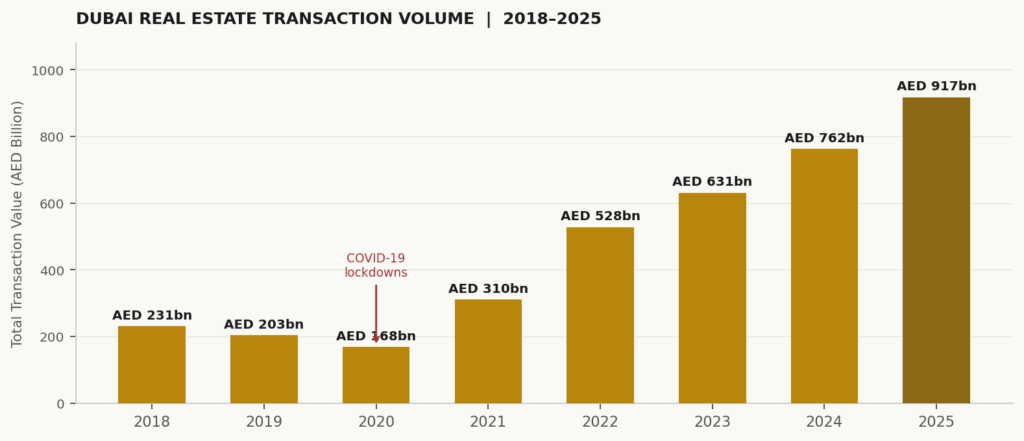
AED 917 billion total real estate transactions in 2025 — a historic record
Today’s Market: A Different Animal
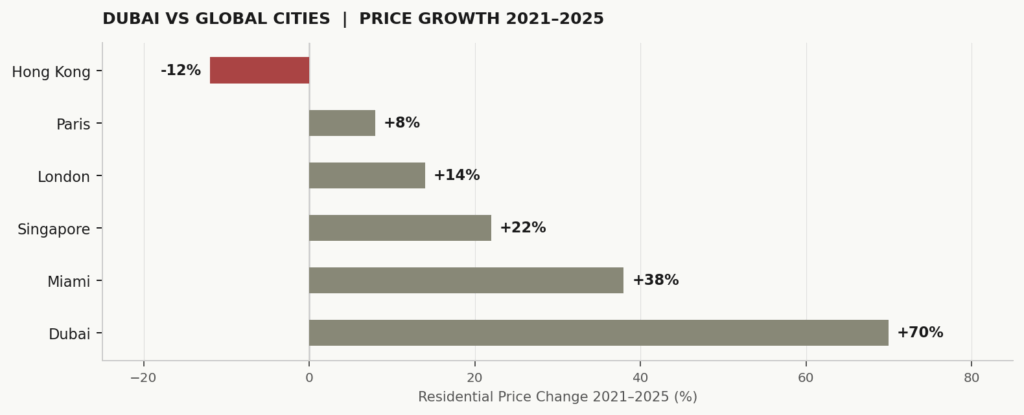
The Dubai real estate market that entered 2026 bore almost no resemblance to the speculative frontier of 2007 or even 2013. In 2025, the emirate recorded AED 917 billion in total real estate transactions — the highest in its history — across more than 270,000 individual deals. Residential transactions alone reached AED 538 billion. Since 2021, housing prices had risen between 60% and 75%. The DFM Real Estate Index had gained 63% in 2024 and 38% in 2023. Every major metric was at or near an all-time high.
The buyer base had also transformed. Indian investors account for 20–22% of foreign purchases. European, Russian, and broader Middle Eastern capital has diversified the demand pool so comprehensively that no single nationality — or single geopolitical event — can precipitate a systemic exit. Dubai’s Golden Visa program has created a long-term residency incentive that fundamentally changes the investment calculus: buyers are not flipping units, they are building lives. Ultra-luxury transactions — properties above AED 10 million — recorded 990 deals in January 2026 alone, suggesting deep demand at the top end of the market even before the regional tensions of March.
“Dubai’s regulatory framework and robust infrastructure continue to attract international capital. The fundamentals haven’t changed — only the pace has moderated temporarily.” — CBRE Chairman & CEO, MENA
When US-Israel strikes on Iranian targets in early 2026 rattled regional sentiment, the market did correct. The ValuStrat Price Index recorded its first monthly decline since 2020 — down 5.9% in March. Transaction volumes fell 14% year-on-year in early April. Off-plan sales, which had accounted for nearly two-thirds of 2025 transactions, paused most sharply. But the ready-home segment held firm. And critically, even during peak uncertainty, Dubai recorded 3,570 property transactions worth AED 11.93 billion in a single week in early March — a pace that would constitute a record year for most markets on earth.
S&P, Knight Frank, and CBRE all maintained their assessment that Dubai’s structural fundamentals remain intact. Citi’s bear-case scenario — an average 7% annual price decline through 2028 under sustained regional conflict — would, in context, represent a modest and manageable correction against a 60–75% run-up since 2021. It would not represent a crisis. It would represent a market breathing. And in my experience, markets that breathe are markets that last.
The Government’s Answer: Policy as a Stabilizer
Every time Dubai has faced a crisis, the government has responded with something more durable than sentiment: structural policy. The current episode is no different. While analysts debate the depth of the correction, the leadership is already moving the pieces that will define the next cycle. I have watched this dynamic long enough to know that what gets announced quietly during a downturn is often what drives the next record year.
Here is what has been put in place — and what it means in practice:
— Real Estate Sector Strategy 2033. Unveiled by the Dubai Land Department and tied directly to the Dubai Economic Agenda D33, this strategy sets binding targets that frame the entire decade ahead: doubling the sector’s GDP contribution to AED 73 billion, growing transaction volumes by 70%, raising total market value to AED 1 trillion, and increasing homeownership rates to 33%. These are not aspirational slogans. They are government-backed performance indicators with institutional execution behind them. A market governed by a roadmap of this ambition does not quietly fade.
— Golden Visa reform — the February 2026 circular. In a move that has received far less attention than it deserves, a federal policy circular issued on 20 February 2026 removed the requirement that Golden Visa applicants pay at least 50% of a property’s value upfront. Eligibility is now determined solely by the DLD-certified valuation reaching AED 2 million — regardless of mortgage balance, payment stage, or off-plan status. This single change unlocks a significant new pool of mid-tier global investors who previously could not tie up AED 1 million before handover. Mortgage brokers are already projecting a surge in 80–85% LTV products packaged specifically for residency-driven buyers.
— Unified residency platform — GDRFA–DLD MoU, April 2026. On 24 April 2026, the General Directorate of Residency and Foreigners Affairs (GDRFA) and the Dubai Land Department signed a memorandum of understanding that folds three separate residency pathways — the 10-year Golden Visa, the Retiree Visa, and the Property Owner Visa — into a single digital channel. Upon purchasing a qualifying property, the DLD system automatically notifies GDRFA to initiate residency card issuance. For an international investor making a decision between Dubai and a competing jurisdiction, the friction cost of obtaining residency has just been cut materially.
— Dubai 2040 Urban Master Plan. Running in parallel to the real estate strategy, the 2040 Master Plan designates five urban centers across Dubai and commits to expanding green and recreational space to 60% of the city’s total area. It provides developers and long-term investors with a 15-year visibility window on where infrastructure, density, and connectivity will be concentrated. In a market where location premium is everything, government-confirmed spatial planning is a pricing catalyst.
— Rental market stabilization — Q1 2026 data. Even as transaction sentiment paused in March and April, Dubai’s rental market continued to move. Q1 2026 recorded rental contracts worth AED 32.2 billion — with 118,385 new leases and 135,607 renewals. Cancelled contracts fell 25% year-on-year, pointing to a more stable landlord-tenant cycle. The DLD’s unified rental system has reduced disputes, improved enforcement, and maintained yield visibility for buy-to-let investors.
— D33 FDI target and institutional pipeline. The Dubai Economic Agenda D33 targets a doubling of annual foreign direct investment inflows — from AED 32 billion to AED 60 billion per year, with a cumulative goal of AED 650 billion by 2033. Real estate is an explicit beneficiary of this pipeline. As global companies expand their MENA footprint through Dubai, they bring with them workforce housing demand, commercial leasing activity, and executive residential purchases. The institutional pipeline is not an abstract projection; 110,000 new real estate investors entered Dubai’s market in 2024 alone, most of them international.
Taken together, these measures represent a government that is managing a cycle — with the institutional clarity to distinguish between the two.
The Pattern Is the Proof
Dubai’s real estate history is not a story of uninterrupted success. It is something more instructive: a story of repeated crisis, structural response, and stronger subsequent performance. In 2008, the market collapsed under the weight of speculation. The government rebuilt the regulatory architecture. In 2013–2016, the market softened under supply excess and oil dependency. Dubai diversified its economy and its buyer base. In 2020, COVID shut the world down. Dubai reopened first and recorded its best-ever years in 2021–2025. Through every episode — the Arab Spring, the Russia-Ukraine war, the 2022 Russian capital flight that ironically accelerated Dubai’s luxury market — the city absorbed the shock and emerged larger.
This is the product of deliberate governance, infrastructure investment, and a sustained commitment to remaining the region’s most commercially accessible city. Neutral in geopolitics, sophisticated in regulation, and ruthlessly competitive in attracting global capital — Dubai has built a machine that is designed to attract money when money is looking for safety.
The Verdict
The current moment — the US-Iran tensions, the pause in buyer activity, the modestly declining indices —is a chapter in a pattern that has repeated itself with remarkable consistency over two decades. Each episode has produced noise, fear, and headlines. Each episode has produced, in its wake, a buying opportunity for those who understood what Dubai actually is.
What Dubai actually is: a market that has graduated from speculation to sophistication, from fragility to structural resilience. A city where 270,000 property transactions are completed in a single year. Where regulatory frameworks protect buyer funds. Where a Golden Visa program creates genuine long-term demand. Where tourism, finance, logistics, and technology have replaced oil as the pillars of economic gravity.
I have spent 25 years watching this region react to shock. The investors who panic and exit are rarely the ones who build lasting wealth. The ones who read history, understand the structure, and move with conviction when others hesitate — those are the ones this market has consistently rewarded.
Crises come. Dubai bounces back. The data, across eighteen years of stress-tested evidence, permits no other conclusion.