

- The 2025 business year: sales revenue of 91.0 billion euros / EBIT margin from operations of 2.0 percent / free cash flow of some 300 million euros.
- Outlook for 2026: sales growth of 2–5 percent / EBIT margin from operations of 4–6 percent / positive free cash flow.
- Innovation leadership: high upfront investments in areas of future importance secure a technological edge and strengthen growth opportunities.
- Stefan Hartung: “Bosch can deliver the future – even under unfavorable conditions. 2026 will be a year of progress.”
- Markus Forschner: “Competitiveness is the foundation for profitable growth – it secures our investments for the future.”
In the face of geopolitical tensions and trade barriers, the Bosch Group intends to exploit the growth prospects in its global markets with full innovative strength in the 2026 business year. The necessary upfront investments in areas of future importance are set to remain at the high level of previous years. In 2025 alone, Bosch devoted some 12 billion euros to investments in research and development and to capital expenditure. The supplier of technology and services is planning sales growth of 2–5 percent and an EBIT margin from operations of 4–6 percent for 2026.
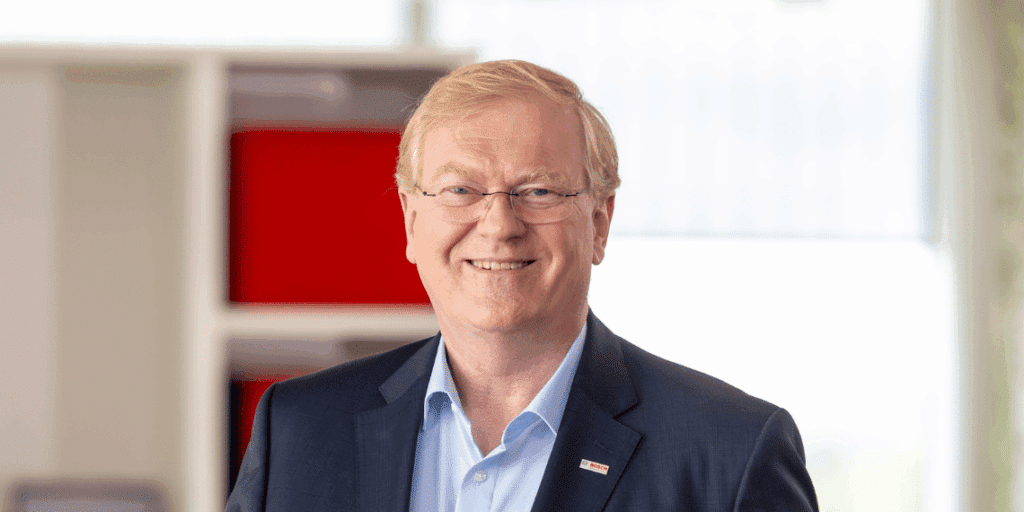
Referring to the presentation of the company’s annual figures, Stefan Hartung, chairman of the board of management of Robert Bosch GmbH, said: “As a global technology leader, we are committed to shaping the trends of automation, digitalization, electrification, and artificial intelligence, as this also paves the way for profitable growth in our business. An important prerequisite for this are the cost-cutting effects of the structural measures we have already initiated and innovations in all business areas.”
When it comes to innovative strength, Bosch is one of the strongest industrial companies in the world and one of the most prolific patent applicants in Europe. Bosch registered around 6,300 patents in 2025 and was once again the leader in Germany.
Despite considerable challenges, Bosch was able to achieve sales revenue of 91.0 billion euros in the 2025 business year, slightly up on the previous year (2024: 90.3 billion euros). After adjusting for exchange-rate effects, this was equivalent to 4.1 percent growth. At 2 percent, the EBIT margin from operations was below the previous year’s figure (2024: 3.5 percent). Necessary structural and personnel adjustments to increase future viability had a considerable negative impact on result in the form of provisions of 2.7 billion euros.
Business Outlook 2026: Generate Financing for Areas of Future Importance
Bosch believes that the weak economic development of 2025 will continue in the current business year. High levels of uncertainty, primarily due to geopolitical developments with the as yet unpredictable effects of the war in the Middle East, are likely to continue to affect inflation and global economic output. Moreover, price and competitive pressure remains high.
Nonetheless, in the first three months of the year, Bosch was able to keep its sales more or less at the previous year’s level; after adjusting for exchange-rate effects, revenue was some 5 percent higher. Bosch expects the global economy to achieve only moderate growth, at the level of recent years.
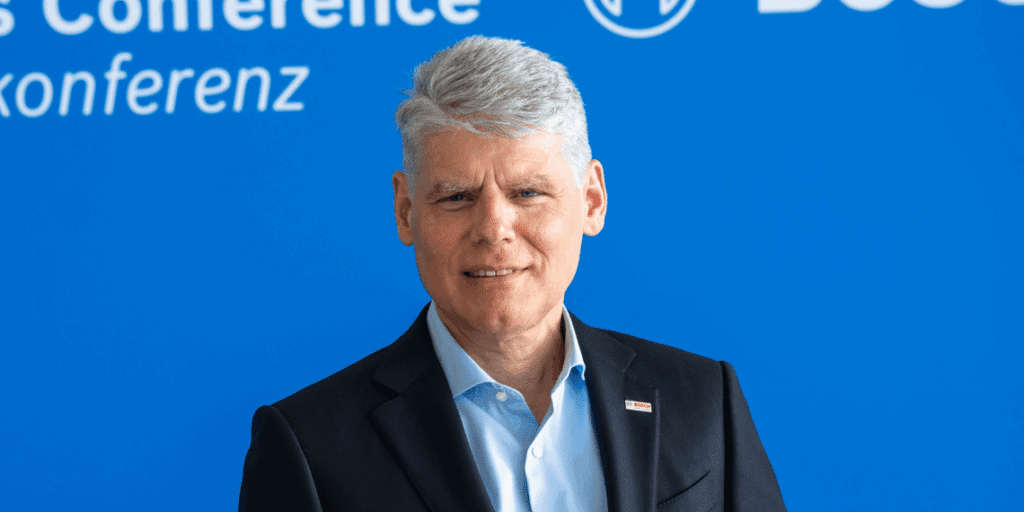
“The foundation for profitable growth is our competitiveness – which is why we’re working hard to increase it further,” said Markus Forschner, member of the board of management and chief financial officer of Robert Bosch GmbH. “This strengthens our resilience in the face of upcoming challenges and at the same time boosts our investment capacity for the future.”
In light of strategic opportunities and as a financial precaution, Bosch is expanding its scope accordingly: to ensure it will be able to issue financial instruments such as bonds more flexibly during the year, the company will for the first time publish interim consolidated financial statements and an interim group management report for the first half of the current business year.
On this point, Forschner said: “This improves our ability to access the capital markets, even though we already have a strong capacity to finance our business from our own resources.”
Strategy 2030: Innovation and Differentiation to Boost Growth (Continued)
To achieve successful business development in an adverse global economic environment, the company must keep its costs at a competitive level. With the conclusion of talks with employee representatives on the necessary job cuts at all affected Mobility locations in Germany, Bosch is improving its future competitive position in the face of increasing price pressure.
“The negotiations weren’t easy, but both sides demonstrated a marked sense of responsibility,” Hartung said. “We are now implementing the agreed measures as quickly and consistently as necessary, but also in as socially acceptable a manner as possible.”
In the automotive industry, China is currently setting the standard for price levels. Hartung therefore sees the expansion of innovation leadership as a key success factor for expanding business, particularly in the automotive market, and implementing the company’s Strategy 2030, which foresees Bosch being one of the three leading suppliers in its key markets.
Trade barriers and different user expectations are currently both a challenge and an opportunity for regionally adapted solutions. “In international competition, it’s not just about costs, but above all about differentiating ourselves,” Hartung said, referring to Bosch’s global footprint, which he sees as a competitive advantage.
“We can adapt our offerings and supply chains to regional conditions and at the same time deliver global-level quality.”
Sensor Technology as an Innovation Field: Automation and Robotics Secure Sales
Bosch is driving forward numerous innovations in microelectronics and sensor technology and expects its consistent focus on technology that is “Invented for life” to provide considerable growth impetus. Experts suggest that the global market for sensors could be worth more than 440 billion U.S. dollars by 2031.
Bosch stands to benefit from growth in the potential applications: the company’s sensors are playing an increasingly important role in robotics. The BMI5 sensor platform, for example, creates artificial environments extremely realistically and helps robots find their way around even under difficult conditions.
With this, its most powerful sensor solution to date, Bosch considers itself well positioned for a rapidly growing segment. In the field of automated driving, inertial sensors are regarded as a key component of the future and offer additional sales potential. They enable cars to maintain full awareness of their whereabouts even when camera or GPS signals aren’t available.
“These sensors work for an automated car in much the same way as the sense of balance does in the human inner ear,” Hartung said. According to analysts, the market for intelligent sensors in automotive applications is set to almost double to more than 80 billion U.S. dollars by the middle of the next decade.
Innovations in Mobility, Consumer Goods, and Services
Mobility Innovations
Bosch expects the market for automotive software to be worth around 200 billion euros by 2030. As a result, Bosch chairman Hartung sees great growth opportunities in software-defined mobility.
“Bosch is at the forefront in this area and is now literally bringing AI into the driver’s field of vision,” Hartung said. The new Bosch AI Extension Platform is an AI-capable high-performance computer that, in conjunction with an interior sensing solution, turns driving into a highly personalized experience.
Product innovations in intelligent driver assistance solutions are also generating new business across all regions of the world: together with sensor technologies and central vehicle computers, Bosch secured orders worth 10 billion euros in 2025.
“This year alone, we will deliver more than 7 million solutions and components for electric driving.”
Bosch also announced a joint venture with Tata AutoComp Systems in India focusing on electric axles and motors.
Consumer Goods and Services Innovations
AI is providing significant growth opportunities in the services and product business as well. A new oven model with an AI-based voice function is securing new sales potential for the BSH Hausgeräte division.
The worldwide business with home appliances in the luxury and premium segment is expected to continue to grow, particularly in North America. Market experts estimate that global sales of home appliances will reach around 5 billion units by 2030.
AI is also driving product innovation in Power Tools, including new AI-enhanced tools such as wall scanners using radar technology.
Bosch’s services business is also benefiting from AI, with Bosch Global Service Solutions expecting double-digit average sales growth by 2030.
Financial Overview 2025
Bosch achieved a positive free cash flow of some 300 million euros in 2025 (2024: some 900 million euros). The R&D ratio stood at 8.7 percent of sales (2024: 8.6 percent). Expenditure on research and development amounted to 7.9 billion euros.
Capital expenditure remained at a high level, and Bosch made considerable investments in electromobility, semiconductors, and braking systems.
At 41.6 percent, the equity ratio also remained high (2024: 44.3 percent). Liquidity fell to 7.4 billion euros (2024: 8.2 billion euros).
Business Sector Development 2025
- Mobility: 55.8 billion euros revenue, EBIT margin 1.8 percent
- Industrial Technology: 6.5 billion euros revenue, EBIT margin 3.5 percent
- Consumer Goods: 19.9 billion euros revenue, EBIT margin 3.0 percent
- Energy and Building Technology: 8.5 billion euros revenue, EBIT margin 0.5 percent
Regional Development 2025
- Europe: 44.2 billion euros (–0.6 percent)
- Americas: 18.5 billion euros (+3.8 percent)
- Asia Pacific: 28.3 billion euros (+0.7 percent)
Headcount Development 2025
Worldwide headcount stood at 412,774 associates at the end of 2025 (2024: 417,859), a reduction of around 1 percent.